

Category Archives: FORE Magazine

pground

SCGA: The Playground Opens At Goat Hill Park

pground

As John Ashworth has learned many times since taking over management of Goat Hill Park in Oceanside three years ago, renovating and running a golf course is far from child’s play, even when you’re building a kids’ course.

Last November, Goat Hill completed work on a three-hole kids’ course adjacent to its driving range that opened for public play – free for kids – in August.

Building a three-hole course on which shots range a mere 25-50 yards may sound simple, but Ashworth can attest that’s hardly the case.

Built in part to fulfill an obligation as part of his original agreement with the city, the project involved clearing the undulating parcel of scrub brush and tumble weeds and dumping 200 truckloads of dirt to be shaped before the greens could be built and irrigation and turf added.

The former eye sore is now a verdant Playground – the name of the kids’ course – of growing grass meant to help grow the game.

“You want to get (kids) exposed to the game early, and this is just enough to do it,” Ashworth said, noting the course will be open to kids of all ages, many likely playing the course and its rolling terrain with just a putter.

Famed golf architect Gil Hanse and one of his associates, Shaymus Maley, assisted on the three-week project. Hanse happened to be in Carlsbad re-working Callaway Golf’s practice range when Ashworth reached out for a design and landscape assist.

“I’ve known Gil for a while and he offered to help years ago if I needed anything, and I finally took him up on that,” Ashworth said. “I’m not shy about asking people to help us.”

That includes the community as well. Ashworth ran a public donation campaign on generosity.com and promoted it via social media to solicit funds and raised the $45,000 required in relatively short order. That money, and a contribution from the Wadsworth Golf Charities Foundation, really made the project possible, Ashworth said.

According to its web site, the Wadsworth Foundation is “dedicated to improving communities through the embodiment of the moral, ethical and cultural codes of the game of golf.”

“There’s always cost involved, but people and some of the golf companies were really great. In particular Toro, Callaway Golf, Gillibrand and Landscapes Unlimited were very kind in helping.”

Ashworth said the idea for the kids’ course came to him during his travels through Europe.

“When you’re traveling through Scotland and Ireland, you notice that a lot of places have a little kids’ course,” he said.

And Ashworth emphasizes that the course will be a course and not just a short-game area. Goat Hill already caters to kids and juniors as home to the North County Junior Golf Association. President of the NCJGA and instructor David Emerick said the kids’ course will be more than a place to just put a club in a kid’s hands.

“It allow us to teach them rules of the game and etiquette as well as pace of play,” he said, noting that parents will be encouraged to caddie.

But play on “the playground” will naturally be the main draw.

“I envision a lot of little kids using a putter and one ball until you can go to level 2 and then you can use a 7 iron. But putter is enough to start,” he said. “It’ll be a transition course to the big course.”

Emerick said the course will also be a natural place to foster and nurture the relationships the game facilitates.

“We like to get to know all the kids and families,” he said, adding that the NCJGA has around 400 members. “We’re very hands-on in working with them and trying to create friendships.”

Goat Hill General Manager Eli Ivey is similarly excited about the possibilities for the kids’ course to contribute to growing the golf culture at Goat Hill.

“You start them young and then hopefully that carries over and they decide to become part of the Goat family,” Ivey said.

Ashworth, who also owns and operates the Linksoul golf lifestyle clothing line, took over the Goat Hill project three years ago after the property was targeted for re-development by the city.

At the time, the neglected course had conditions much like the barren hardpan found on many driving ranges. Ashworth’s efforts to revive the course and restore aesthetically pleasing conditions have been lauded in many circles.

The course, which opened in 1952, is entering its second full year of operation under Ashworth’s care. He said the journey has been trying at times but ultimately rewarding and one that continues to evolve and generate support from the community, as the recent donation campaign showed.

“It really shows the support the whole project has had. (What we’re doing) resonates with people. We’re kind of like the little engine that could,” Ashworth said, adding that profits at the course have all been re-invested in course maintenance and maintaining course conditions.

A course that once had a shaky and uncertain future now seems solidly re-established and Ashworth and his staff can now focus on fostering a future based on growing the game.

“We’ve been very lucky,” Ashworth said. “We’ve had a lot of things go our away. It seems like somebody has been looking out for us and that the universe wants us to be here. We’re in a good place.”
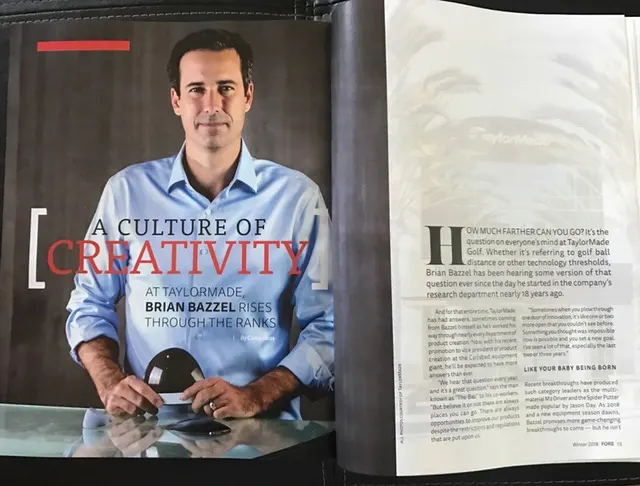
Bazz mag spread

FORE Magazine: Meet TaylorMade’s Vice President of Product Creation Brian Bazzel

Bazz mag spread

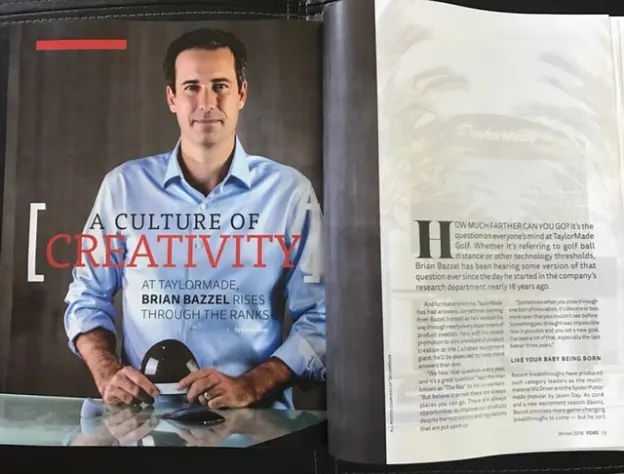
Editor’s note: Here’s my profile of TaylorMade’s Brian Bazzel for the winter issue of FORE Magazine. I’ll post a digital link when one comes available.

How much further can you go? It’s the question on everyone’s mind at TaylorMade Golf. Whether it’s referring to such things as golf ball distance limits or other technology thresholds, Brian Bazzel has been hearing some version of the question ever since the first day he started in the research department of TaylorMade nearly 18 years ago.

And for that entire time, TaylorMade has had answers, sometimes coming from Bazzel himself as he’s worked his way through nearly every department of product creation. Now, with his recent promotion to vice president of product creation, he’ll expected to have more answers than ever.

“We hear that question every year. And it’s a great question,” says the man known as “Baz” to his co-workers. “But believe it or not there are always places you can go. There are always opportunities and doors that are open to improve upon our products despite the restrictions and regulations that are put upon us.

“Sometimes when you plow throw one door of innovation, it’s like one or two more open that you couldn’t see before. Something you thought that before was impossible now is possible and you set a new goal. I’ve seen a lot of that, especially the last two or three years.”

Recent breakthroughs have produced such category leaders as the multi-material M2 Driver and the Spider Putter made popular by Jason Day. As 2018 and a new equipment season dawns, Bazzel promises more game-changing breakthroughs to come – but he isn’t tipping his hand just yet.

“We have some incredible technologies coming out that I can’t wait to tell the world about,” he said. “It’s going to be a significant year.”

In a way, it has already begun. The new equipment has already been tried and tested by TaylorMade’s armada of Tour pros. Their feedback and input is a major source of inspiration for future TaylorMade product, so their buy-in and belief is critical, Bazzel said.

Thus presenting product to Tour pros being Bazzel’s most nervous moment of the year.

“It’s like your baby being born,” Bazzel said. “It’s the moment of truth.”

tmade hq

That moment can be three to five or even more years in the making. That’s how far out TaylorMade’s product planning and R & D extends. In actually, though, a product’s life truly begins 2 years out when it’s put into a planning and production cycle.

Now more than ever, Bazzel, like an NFL general manager planning a draft, will be the one making those selections.

“We have several ideas that are 3-5 years out, but you only have so many people and so much time so you have to choose correctly,” he explained. “Some of those ideas will never see the light of day but you hope that most of them will.

“Two years to 18 months is when we get really serious about a product.”

Bazzel is uniquely positioned to make those decisions in that at one time or another, he’s worked in every equipment category at TaylorMade, but upon announcing Bazzel’s promotion, TaylorMade CEO David Abeles especially lauded Baz’s work in metalwoods.

“For five years, Brian has been the driving force behind our metalwoods product creation team, creating groundbreaking products that have invigorated the industry,” Abeles said. “His vision has helped position TaylorMade as the industry leader in metalwoods innovation and performance.

“There’s no doubt in my mind that under his guidance the TaylorMade brand will continue to see exceptional growth and forge a lasting position as an industry leader across all product categories.”

Bazzel developed his knack for product design after a stint of playing competitively and then caddying. Bazzel played high school golf in Rancho Bernardo before going on to play at Division III UC-San DiegoSD, where the team captured third in the NCAAs once during his playing days. Bazzel competed in SCGA amateurs and on the mini tours before taking a caddy gig at The Farms Golf Club in Rancho Santa Fe.

A caddy client noted Bazzel’s knowledge and knack for the game and suggested a career in the industry. Armed with his playing experience and an electrical engineering degree, Bazzel embarked on a career with TaylorMade.

Bazzel’s love for the game was fostered by his step father, a scratch golfer. His influence has carried over to Bazzel’s design career in that he’s the audience Bazzel says he has in mind when he’s creating a product.

“When I think of an authentic golfer, I think of him,” he said.

Bazzel said his love for the equipment side of the game came later in his playing days, but he recalls clearly his first real set of clubs, which were TaylorMade irons he purchased at age 13 with money earned washing dishes.

“They were long irons, foam-filled, Tour-preferred,” he says with a smile. “I paid $300 and sold them for what I paid them. I wish I still had them.

“I was proud to have them and eager to hit them.”

That’s the emotion Bazzel seeks to conjure now each year from golfers.

Thanks to advances in technology, the process of product creation has changed drastically during Bazzel’s time at TaylorMade, but the process of gathering ideas remains largely the same, he said. He keeps his eyes and ears open at all times, he said, especially when talking to Tour players.

“You find inspiration everywhere,” he said. “The ideas we have implement can come from anywhere. You’re always listening for insights, especially when we’re talking to our PGA professionals from around the world.

“But we have to be within the game and close to the game at all times so we hear those things.”

The objective for the staff of 15 that Bazzel now oversees is clear, he said.

“We ultimately want to have the deepest understanding of what golfers want and then also have the deepest understanding of what our brightest minds have come up with it,” he said. “Then you want to align those two things and hopefully surprise them at times.

But for all the planning and research, Bazzel says it’s sometimes the staff who ends up getting surprised, as was the case with the Spider Red mallet putter that Jason Day rode to world No. 1 and has become popular on Tour.

Day requested a few design tweaks to the original model, Bazzel said, adding that the red color choice was Day’s entirely, a decision that he says initially drew skeptical glances from the staff.

“It looked a little different and a little funny,” Bazzel said. “But then he starts make every putt on the planet and suddenly we can’t make them fast enough.

“So for all the planning we do, there are still some things you can’t plan for.”

But Bazzel said the product was ultimately a triumph for the culture of TaylorMade, where each product category has a group leader, but Bazzel said that doesn’t limit the staff’s ability to contribute across other product lines.

“Everybody fits the culture of TaylorMade, but yet is each uniquely skilled. The talent in this building is incredible and there are no egos,” he said. “We want people to feel like they can contribute anywhere at any time.

“We’re always willing to help each other because we’re all ultimately going after the same thing, which is to create the best-performing, hottest golf products on the planet.”

xander cover

strawberry draft

FORE Magazine: Strawberry Farms Dining 19th Hole Feature

California omelet

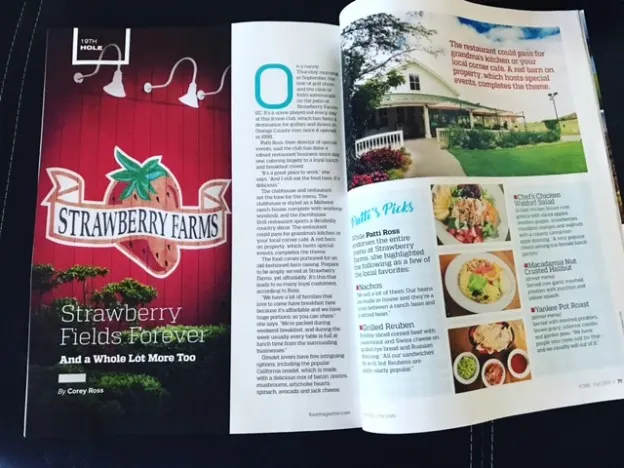
On a sunny Thursday morning in September, the tink of golf shots and the clink of forks intermingle on the patio at Strawberry Farms Golf Club, which overlooks its driving range.

It’s a scene played out every day at Strawberry Farms, which has been a destination for golfers and dinners in Irvine ever since it opened in 1998.

Strawberry Farms Director of Special Events Patti Ross said the club has done a robust restaurant business since day one and continues to, catering to largely a loyal lunch and breakfast crowd.

Follow the link to read the rest of this story in the digital version of FORE.

strawberry draft