Tag Archives: Course review

Arroyo triple

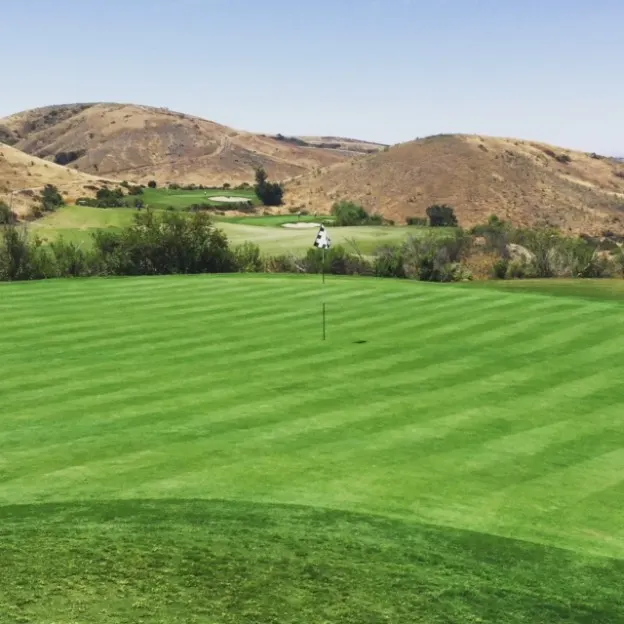
19th Hole Media: Five Great Reasons To Play Arroyo Trabuco

Arroyo triple

Since it opened in 2004, Arroyo Trabuco Golf Club has been home to some of the best golf played in Orange County and Southern California. Designed by PGA Tour professional Tom Lehman and well-respected local course architect Casey O’Callaghan, our course offers five set of tee boxes, playing for 5,045-7,000 yards in a park-like setting which offers something for every level of golfer. How much challenge are you ready for?

What follows is an overview of our playing experience that offers some insight into what it’s like to play a round with us. Who’s ready to tee it up? Let’s go.
Arroyo Adjusted

The Sound of Silence: If you like your golf with a side of peace and tranquility, we’re the destination for you! Just minutes away from the hustle and bustle of the I-5, you’ll discover our course, which is bordered by a hiking trail and surrounded by nature. The only house in sight is our clubhouse. We truly are an escape, be it for golf or dining – or both! Our patio overlooks the 18th green and a pond and provides a serene setting to enjoy a meal, a drink and/or quality time with friends and family. There are no bad days or bogeys on our 19th Hole.
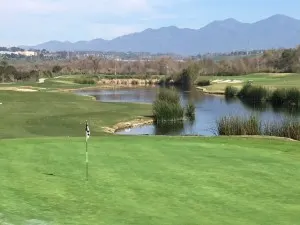
Arroyo 18

Bring Your Driver – and Swing Away: Arroyo Trabuco is unlike some target golf courses in the area, or those that require a lot of local knowledge, in that our course is pretty straightforward. See it. Hit it. You’ll find our opening holes especially inviting. They offer spacious fairways and generous greens while remaining challenging. You can grip and rip and hopefully get off to a strong start while playing holes over mostly flat terrain for the first five holes. That’s about to change.
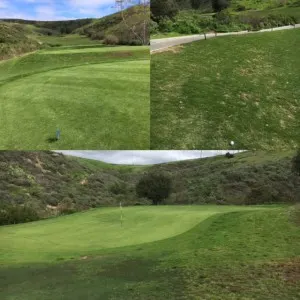
No. 6

Up, Up, Up: Our short, strategic par-4 6th plays straight uphill and is a local favorite for its risk/reward properties. You can safely play for position off the tee or press your luck and go for the green. Everything from eagle to double bogey is in play here depending on your strategy.
No. 6 also starts a climb above the canyon where a series of holes awaits with breathtaking views that combine the thrill of elevation changes with the challenge of forced carries that demand your best in terms of shot making and strategy. You may reconsider how you club a few holes after playing them a time or two.
The vistas provide previews of the holes to come, particularly at the turn, where holes 10, 11 and 12 are all simultaneously in view. But don’t get ahead of yourself. One hole at a time is plenty as you negotiate a stretch of our course that’s as potentially scoreable as it is beautiful.
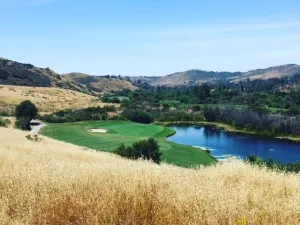
No. 13

No. 13: As you begin your descent, you come to a real visual change of pace. For the first time in your round, you see water at the aesthetically pleasing par-3 13th. A sizeable pond guards the right side of this risk/reward mid-length hole. Do you risk the water, which has a reputation for being a bit of a ball magnet, and go for the pin or do you take a safer route and take advantage of the spacious bail out area to the right?

You’ll likely be asking yourself on the tee: Am I feeling lucky? Your answer will likely decide the outcome.

Finish Strong: Like any great book or movie, a great golf course should provide a memorable and satisfying finish – and our course provides one. Arroyo Trabuco closes with a 1-2 punch of a challenging par 4 and scoreable par 5, both sharing a common boundary lake – the one you see from our patio.

Arroyo 18

The setting for a memorable finish is in place. Will you write a winning ending or a tear-jerker? Much as our course begins, two welcoming fairways await. Two well-struck drives will put you in Position A to bag a birdie on the way home and give you a winning walk-off to your round with us. We’ll often have staff waiting for you at the 18th green to shake your hand, clean your clubs – and welcome you to come try it again. Anyone in the mood for 36?
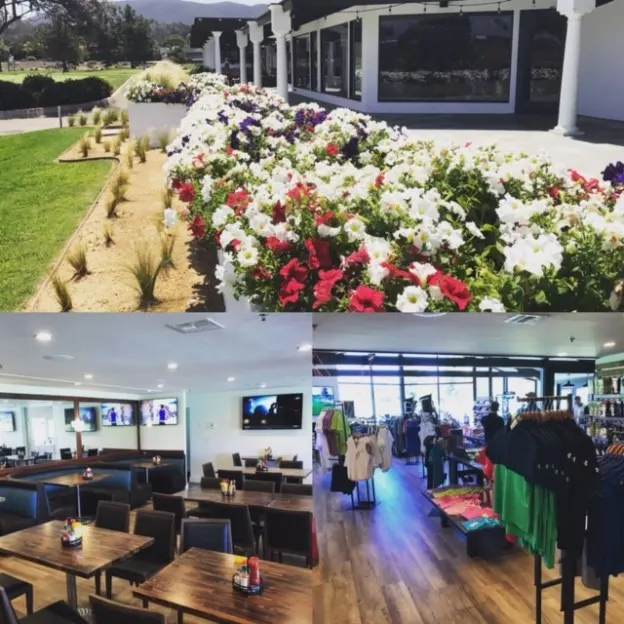
St. Mark clubhouse

Four Observations About The Playing Experience At St. Mark Golf Club

St. Mark clubhouse

I started playing St. Mark Golf Club in San Marcos about five years ago when I was a student at the Golf Academy of America. To be honest, though being close by, it wasn’t one of my preferred tracks, largely due to spotty course conditions after years of neglect, including hard greens that often wouldn’t hold approach shots.

I recently returned to St. Mark for the first time in more than two years and am happy to report a greatly improved experience after a major investment in the main course and clubhouse as well an impressive renovation, and really re-invention, of the executive course.

The playing conditions on the main course, including an aesthetic upgrade to the tee boxes, were on par with some of the best in the county and made for a most enjoyable experience re-discovering St. Mark. Kudos to the new management for their vision and execution and for breathing new life into the place. For those who’ve never been, here’s an overview of the playing experience at St. Mark.

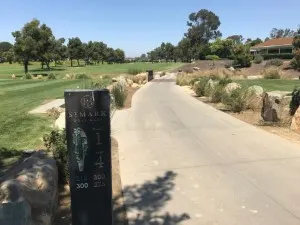
No. 1

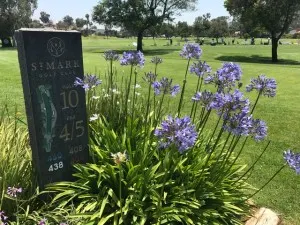
1. A short course – or is it? – At 6,398 yards from the back tees, I don’t think of St. Mark as a long course – by comparison, that’s the yardage at Maderas Golf Club, one of the long courses in SD, from the white tees. Yet St. Mark has one of the longest holes in the county – the 606-yard par 5 12th – and two long par 4s – the 447-yard 4th and 460-yard 10th – that seem to play longer. A lot of holes here are practically dead straight so they play to their full distance.

You definitely need to hit driver well to score here, but the course is wide open enough that accuracy isn’t an absolute must. In the review world, we call this a course that will test your entire bag, which frankly you don’t see coming from the opening holes. This is where St. Mark throws you enough surprises to keep you on your toes.

2. My Nemesis – Excuse the personal aside here, but I’d be less than forthcoming if I didn’t disclose my struggles with the par 4 4th – and I know I’m not alone. This hole is a 447-yard downhill slight dogleg left that often plays into a Pacific Ocean breeze. This is the classic draw hole where my draw won’t draw and I end up with some sort of crazy recovery behind a tree, from an awkward lie, etc.

And when I do hit the fairway, I always seem to have more golf hole left than I should. Forget birdie or par. I honestly can’t recall if I’ve hit the green in regulation here. If I had, that’d be a victory. I certainly didn’t during my last round, where I revisited my classic struggle and scuffled to a six, the first real blemish on my card.

If you get through 4 and 5 – another downhill par 4 – mostly unscathed you’ve got a real chance to get through the front in good shape. The scoring opportunities are there if you avoid the bogey potholes.

14 tee St. Mark

No. 14

3. 12, 13, 14 – These holes are the heart of the playing experience at St. Mark and frankly a stretch you never see coming given the previous 11 holes. The aforementioned 606-yard par 5 12th, a gradual dogleg left with a tricky green, starts this stretch and I’ve seen the mere sight of a “6” on the yardage sign cause people to come undone on the tee. It has psyched more than a few golfers into a snowman. Duff a drive here and you’ll be playing catch up the whole way – and likely never will.

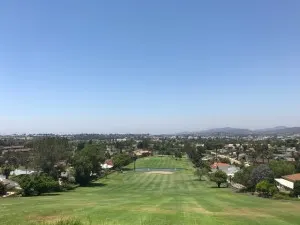
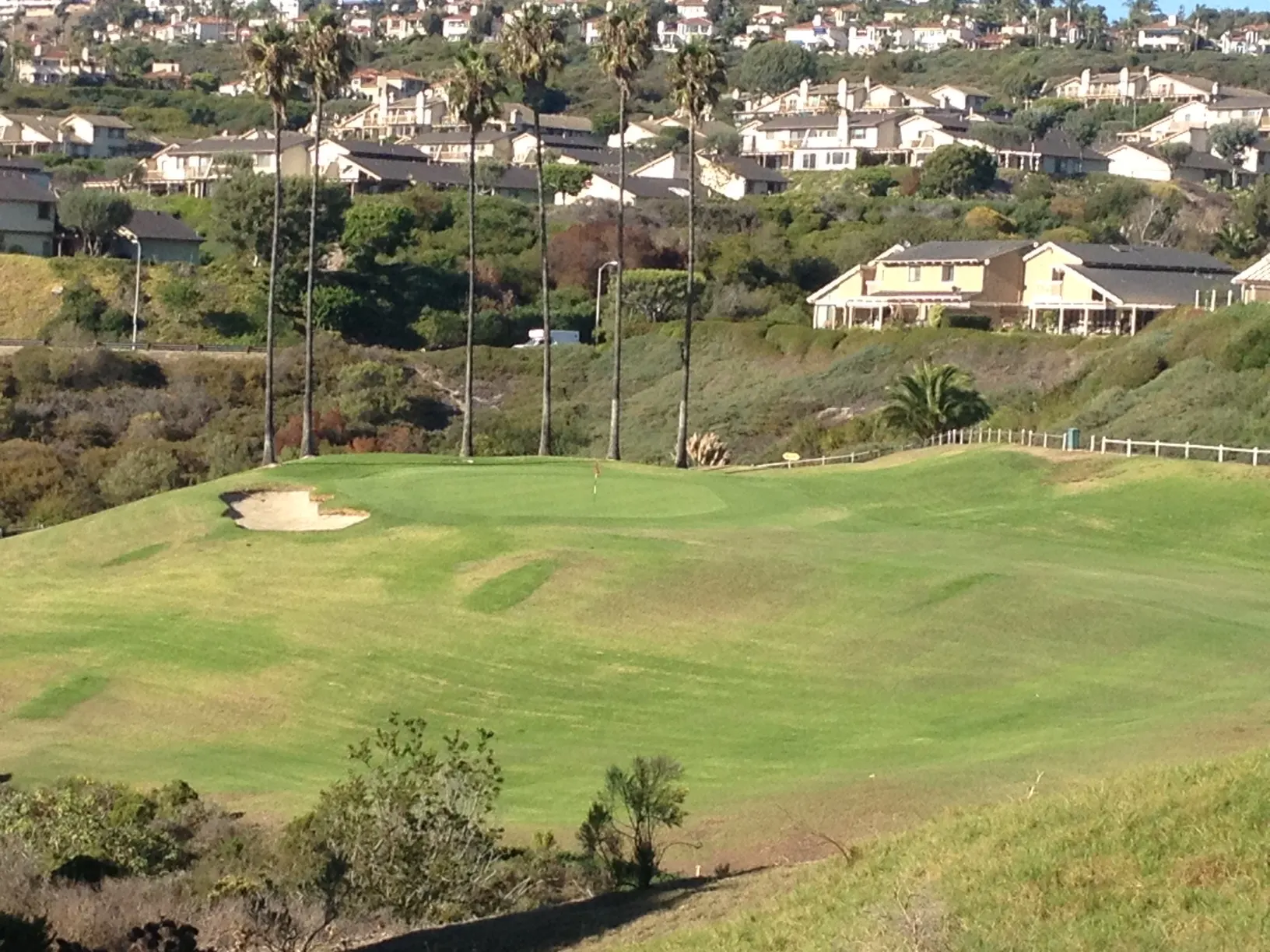
Then a relatively flat course makes a surprise elevation change to an elevated par 3 with a partially blind approach before the course comes to the figurative and literal apex of your round – the elevated 369-yard par-4 14th. With a pond sitting out there dead ahead at around 260 yards, this hole is the ultimate risk and reward. You’re either going for it or you’re not.

In another state and another climate, this hole make a fine ski slope, but it’ll play like a black diamond to you if you can’t make the carry. If you can, you could almost putt your way to par.

There are a lot of great elevated par 4s in San Diego but I can’t imagine a more unexpected one than 14 at St. Mark because it so deviates from the rest of the course. But in that way, it also makes it a tee shot you anticipate and a thrill if you crush it. There’s something to be said for that. Overall, brute distance and a little local knowledge goes a long way in this stretch.

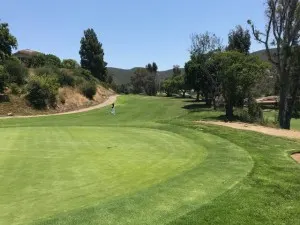
No. 13

No. 13

4. Nemesis Two – If you get through 12/13/14 in good shape, you’ve got a serious chance to post a number on the back. After that stretch, the course reverts back to more of what you expect.

If you don’t trip on the par 3 17th, which is 210 yards but provides room to miss and recover, you come to No. 18, which is another hole where I have a troubled history.

I’ve had a few good scorecards turn bad here trying to do too much here. This par 5 plays to 480 yards, which is a tempting enough number to get you dreaming about a big finish – which can be a big mistake.

The tee shot is straight and sets you up for approach that teases you go for it, despite that gigantic bunker on the left, which is really the only trouble on the hole. The other trouble is all in your head, which again is trying to do too much.

The oddest outcome I ever had here was ripping a 3-wood right at the green – and never finding the ball. (I think we mentioned earlier that the greens previously didn’t always hold shots.)

The smarter play is to try to set yourself up with ideal wedge distance for your third – but where’s the fun in that, right?

And there’s the real trick to mastering St. Mark – knowing when to go for it and knowing when to humbly bag the hero shot and play for par or bogey.

The course is at a length that tempts you, but it has a way of taking strokes back that leaves you sometimes feeling you left a better score out there. Thankfully now that you won’t be feeling like the course conditions cheated you and you’ll admire and appreciate the hard work that has gone into recovering and re-creating a great playing and social experience.

tee marker

Golf Day Trip: San Clemente Muni

Image

While playing Monarch Beach last spring, I received a course recommendation from two Orange County playing partners that stuck with me: the municipal course at San Clemente.

I had been in California for eight months and that one was new to me, even though I’d played in the San Clemente area before.

“Ocean views, great value and a course that will surprise you,” they said. Intrigued, I filed it away for future exploration.

Well, on Monday, I realized my afternoon was open and decided it was a good day for a break from my regular course rotation and recalled San Clemente muni.

What I discovered was a course that fit what I was told to a T and certainly exceeded my expectations. I’ll definitely be back and want to relay to you a little of what makes this course special.

For this feature, I’ll suspend the course review format and just give you an overview, some course history and a few hole highlights.

The course begins in a very familiar muni-style – wide, straight, flat – for the first five holes, but then gradually morphs into a different course and ultimately a drastically different, and unexpected, experience on the back.

I was fortunate to walk on with two playing partners who were very familiar with the course and its history, which I knew very little prior of to Monday.

Here’s a little of the history, courtesy of the course’s web site:

The San Clemente Golf Club has long been a favorite of Southern California golfers. Built by renowned Golf Course Architect William “Billy” Bell on land donated by city founder Ole Hanson, the course consisted of nine holes on opening day in 1930, with what is now the back nine being added in 1955.

         Municipally owned and operated since its inception, the San Clemente Golf Club is aptly known as the “Pride of the Pacific.”

The golf course boasts sweeping ocean views, interesting elevation changes, a challenging-yet-fun layout reminiscent of the golden age of golf, and best of all, reasonable green fees.

         The moderating influence of the Pacific Ocean ensures frost-free winters and cool summer breezes. Popular from its very beginning, San Clemente now hosts roughly 95,000 rounds per year, making the “muni” one of the most popular courses anywhere.            

Those familiar with California golf architecture will recognize William Bell, the designer of many California public courses, including, most notably, Torrey Pines.

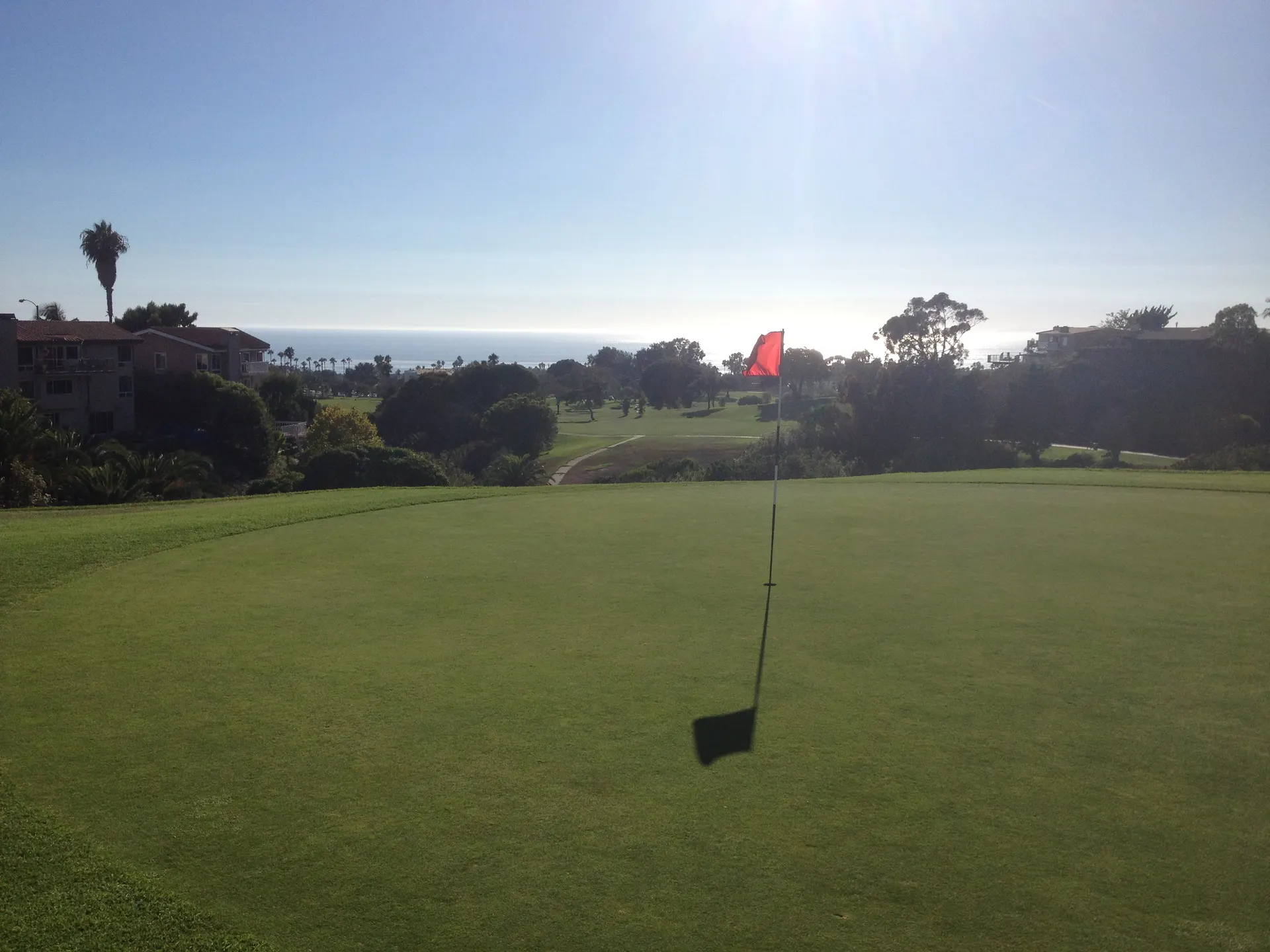
Like I said, the first five holes are fairly straightforward, but then you get to six, which is a dogleg right, uphill par-4. It’s the first time you really have to work the ball and, well, being in the trees on the left, I had my work cut for me.  This hole finishes next to the clubhouse and then you cross the road and discover three holes that foreshadow the experience you get on the back.

There’s an uphill par-5 going out that plays longer than the 485 on the card, and then you’re pointed back toward the coast and get your first true glimpse of the ocean. It provides the backdrop for a whole lot of golf hole – a 419-yard par-4 into an ocean breeze and buffeted by bunkers. Given what you’ve played up until now, it’s a bit jarring to be faced with such a stiff test, but it serves notice that the course plans to challenge you from here on out.

The front nine closes with a terrific little 165-yard (from the blues) par-3 with an undulating green, different than what you’ve mostly played up to know and more like what you’ll find on the back. I underestimated the wind here and flew the green, leaving me a delicate pitch back that stopped well below the hole. (Note: The greens became deceivingly quick on the second nine. Our group didn’t drop many putts.)

Previewing the back, one of my playing partners told me, “You’ve got some very special golf holes coming up.” And after three holes that were more reminiscent of the start of the course, he was right.

Here’s a hole-by-hole of 13 to the finish (yardages from the blue tees):

No. 13, 205-yard par-3: You’ve got the ocean breeze at your back as you stand looking at a fairway that’s steeply sloped on the left side and will kick your ball right. I hit what felt like a flushed 5-iron and came up short. Apparently the hole plays a bit long, too.

         No. 14, 304-yard par-4: Yes, you read that right – 304, seemingly a baby par-4, or is it? Hardly. The whole plays dead uphill through a somewhat narrow fairway to a green surrounded by bunkers. Play for placement here. Iron or hybrid off the tee and then get ready for an approach to a green that slopes away from you. Not all what you’d expect from just looking at the scorecard and the beginning of a golf roller-coaster ride to the finish.

Image

No. 15, 196-yard par-3: An elevated par-3, and the course’s signature hole. And what a view. Again, ocean breeze at your back and gorgeous green and palm trees below. I decided not to club down here and didn’t regret it. I needed every yard and found a little bail-out area right for an up-and-down par. Part of the reward for reaching the green here is that you get your first fully panoramic view of the ocean. And it’s stunning.

No. 16, 387-yard par-4: The trickiest tee shot on the back as it’s a dog-leg left with a huge cluster of trees blocking the middle of the fairway. You can glimpse the green to the left. You choices: Carry a chasm 250 yards and try to get close, or hit it out right and play safe but have a long approach.

What you don’t see from the tee is the drastic drop off in the middle of the fairway. You need to layup to about 150 yards to avoid having a downhill lie to an elevated green. A lot going on here. Choose wisely.

No. 17, 358-yard par-4: The back closes with parallel par-4s. As is often my fate with parallel holes, I found the opposite fairway and ended up chopping out of thick grass. Thus, I recommend hitting the fairway here and taking the easy road on this uphill hole.

Image

     No. 18, 408-yard par-4: You close your round with the ocean on your right and the clubhouse in the distance, a fantastic finishing panorama. It’s a great finishing hole that slopes downhill at around 150 yards to reward big hitters. Provides a great chance for a finishing birdie if you sink that last slick putt.

Since we teed off around 2, when walked off, the sun was setting behind San Clemente Island, which you can get a glimpse of from the practice putting green. It was the last beautiful surprise in a round full of them. I truly enjoyed my round here and will surely be back.